
Will Canada's Regionalism Prevent a Two-Party System?
A Tale of Two Coalitions, Part III: Duverger, Regional Divides, and the Persistence of Liberal and Conservative Dominance

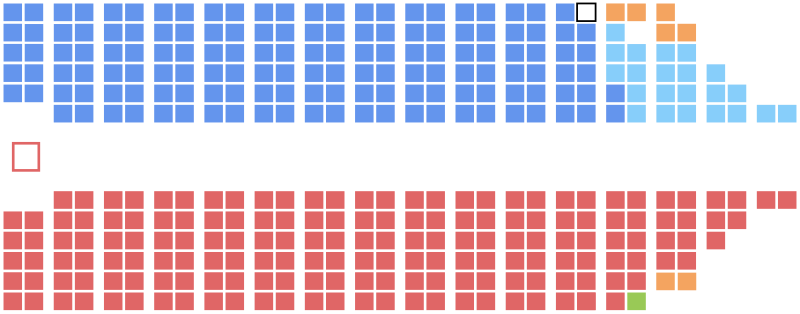
By and far, the possible emergence of a two-party system - wherein the Conservatives and Liberals are the only relevant political players - is the most important consequence of the 2025 election. Should it prove to stick, it will mark a striking departure from the last 100+ years of Canadian federal political history, seemingly ending the ‘two-and-a-half’ party dynamic that has ensured the participation of third party rivals, especially the New Democratic Party.
Such a dynamic would also entail that, after a quite unique pattern of party contestation throughout the 20th century, Canadian federal politics now follows a much more common (if not more Americanized) pattern of competition between two parties, representing either the centre-right or the centre-left.
But how confident can we really be that it will remain in place? And, if it does, how will the broader political environment it produces differ from what came before?
Party systems, as I have already mentioned, endure because they constitute a broader structure that supersedes and constrains party behavior, competition, and performance1. Any good analysis should be able to clearly identify and articulate the mechanisms that strongly push actors towards the same set of behaviors across electoral cycles regardless of the relevant personalities, issues, or events of any given election.
In this post, I start to assess the question of how confident we can be with the idea that a two-party system will persist in Canada. After introducing Duverger’s law, I focus here on one factor that has historically produced multiparty dynamics in Canada - the role of regionalism and insurgent regional parties. Whether the NDP will return as a third national-level party is a question I will return to in the next post.
Duverger’s Law: The Mechanisms of a Two-Party System
Interestingly, as the so-called “Duverger’s Law”, the fact that single member plurality (or FPTP) electoral systems tend to produce two-party systems is one of the most-well known and researched concepts in political science. Taken at face value, it would provide us with good reason to think that a binary structure of competition between the Liberals and Conservatives will grow stronger and more entrenched.

Duverger’s argument is a fairly simple and intuitive one, based on two mechanisms dubbed as the “mechanical” and “psychological” effects.
Mechanical Effect: The way that FPTP translates votes into Parliamentary seats. Because parties only need to win a plurality of votes within a confined geographic area, the way seats are distributed will always underestimate the diversity within the vote.
Psychological Effect: How parties and voters respond. The mechanical effect induces strategic action that favors consolidation around the two parties more likely to get a plurality of the vote. Small parties are disincentivized to form because of the difficulty of gaining votes and representation, instead often opting to work within existing party organizations. Voters are, likewise, wary of ‘wasting their vote’ on a party that is unlikely to perform well and thereby opt to support the ‘second-best’ choice instead.
Although not a fixed outcome, the dynamic of SMP electoral systems producing a structure of competition between two major parties remains a valid and generally quite accurate generalization across advanced democracies. Even while other systems - The United States, United Kingdom, Australia, New Zealand, for example - have some other parties that may gain seats, it is safe to say that access to power is historically controlled by only two competitors.
Applied to the contemporary Canadian case, it would assume that - in so far as the Liberals and Conservatives continue to benefit from the ways votes translate into seats - voters will continue to see support for the alternatives as a ‘waste’, thereby securing (if not deepening) the dominance of the two parties.
Former NDP supporters will, for instance, continue to support the Liberals in so far as they see it as necessary in order to advance progressive goals and keep the conservatives out of power. Likewise, the People’s Party will continue to struggle to grow as it will be unable to make the case for why supporting them has an electoral impact.
What’s important to note here is that - according to this fairly simple model - the actual coherence and stability of the Liberal and Conservative electoral coalitions do not matter all that much in shaping this aspect of the party system. What matters is the extent to which the two dominant players will continue to outsize any other challengers. Because voters and other aspiring political actors will be loath to “waste their vote”, they will deem it to be too costly to support or devote resources to another political movement.2 There will not be, within the scope of any one election, any other viable alternatives.
Canadian Exceptionalism: How Regionalism Subverts Two-Party Consolidation
However, as many readers are certain to have already noted, Canadian federal electoral dynamics have historically never actually followed these expectations. In fact, to global political analysists, Canada has always been the quintessential divergent case that seems to contradict Duverger’s theory. This is because, even while the Liberals and Conservatives have always been the two most dominant players, they have always competed alongside a series of additional challengers that, in many cases, have a decisive say on who remains in power. This has especially been the case for the New Democrats who, at the clear cost of dividing the centre-left, have attained a sizeable and nation-wide level of support.
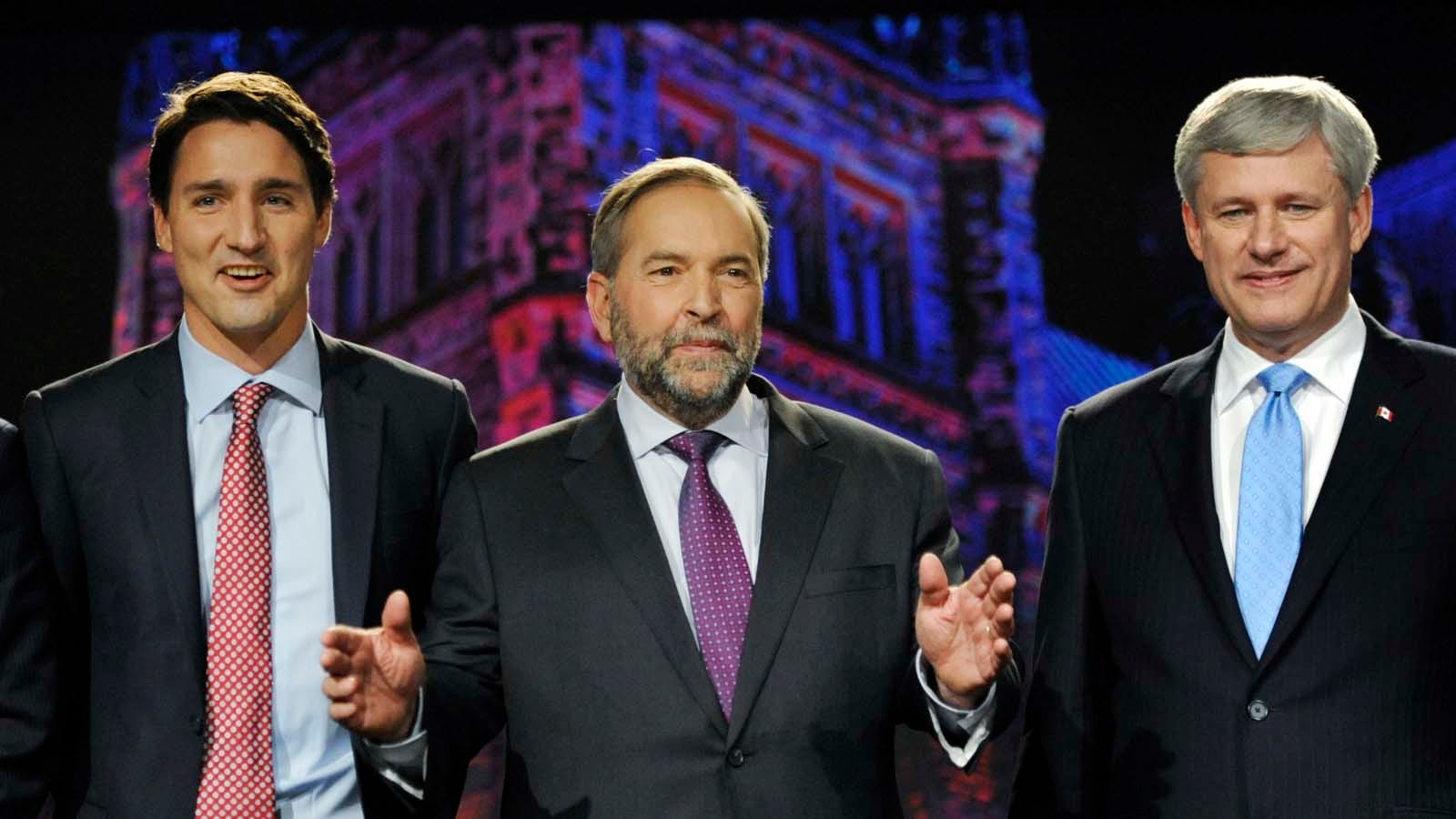
There has, moreover, been a reoccurring pattern of novel insurgent party challengers that, seemingly overnight, acquire considerable public support and representation. They contribute, in part, to a dynamic wherein the federal party system will periodically fragment into a multiparty dynamic organized along regional lines after periods of Liberal-Conservative consolidation. The period between 1993 and 2004 is the most recent and dramatic example. Just take a look at how many parties were represented in the 36th Parliament:
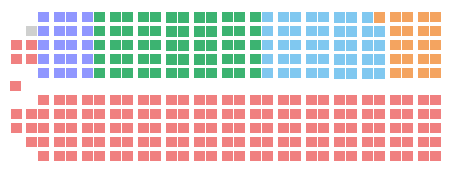
What’s to say that this will not again occur? That the NDP will not bounce back, or that a novel insurgent party, driven by the unmanageability of Carney or Poilievre’s coalitions, will not prove the latter’s hegemony to be short lived?
In making the case that Canada has now developed into a typical two-party case, then, one would also need to demonstrate how the country’s political conditions - the kind that have historically superseded, contradicted, or manipulated Duverger’s more generalizable mechanisms discussed above - have been changed or replaced.
For the most part, analysts explain the Canadian case through recourse to its regionalism. Not only do there continue to be remain objective differences between different parts of Canada (ie. Ontario, Quebec, The West, and the Atlantic), but our decentralized federalist structures and powerful provincial governments make them more pronounced, coherent, and identarian. With the notable exception of Torontonians Ontarians, large swaths of Canadians continue to identify with their province more than their nation. Western alienation is still widely felt.
Throughout Canadian history, the fragmentary push of this diversity has always existed in tension with the consolidating pull of the federal government. The fact that (at the risk of sounding too jargony) strong interstate federalism exists alongside weak intrastate federalism: factors like Parliamentary majorities, a very powerful Prime Minister, an irrelevant Senate, and very top-heavy political parties make it difficult for sectarian interests to have a direct role in the political decision-making process of the federal government. The result is that regional disputes are often explosive, as actors feel both the need and the incentive to impact the federal government through other means, including through establishing rival provincial governments or rival political parties. Often times, rival political movements found success on the local or provincial level before they gained a prominent federal presence.
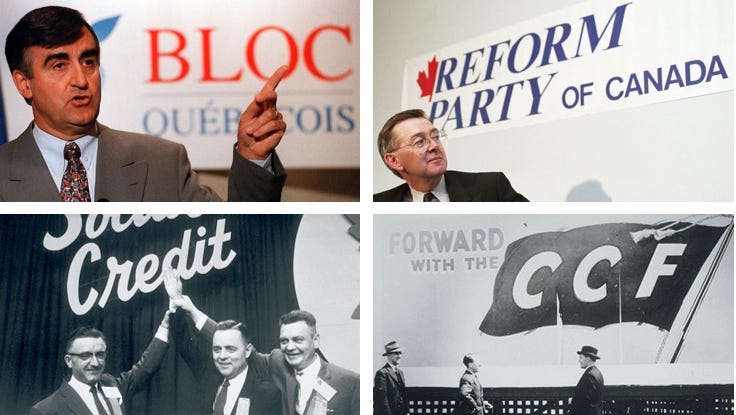
Given that votes matter on a riding-by-riding level in a single member plurality system, smaller parties can easily gain a good amount of representation if they are able to muster locally-concentrated support. And this is precisely what regionalism can provide, allowing for small parties - such as the Bloc Quebecois and various Western protest parties - to secure modest but important presences in legislatures on account of their appeal to particular salient sectarian interests or identities. There are much less barriers to overcome in rallying a sufficient amount of public support here than the kind faced by small parties, like the People’s Party and the Greens, committed to nationwide appeals and a more distributed voter base.
Does Regionalism Still Matter?
This, then, provides some clues to evaluating the possible persistence of today’s two-party dynamic. It would suggest that this would have to come through a significant change to the regionalist politics of Canada, whether this is in regards to its structure or salience.
Now, I should make the caveat here that there is a long conversation to be had about regions and regionalism in Canada (what, after all, even is a region?). We can very quickly get lost in the weeds.
But what I will say is that, at least when it comes to the salience of the historical regional divides themselves, it doesn’t seem like all that much has changed. We are, after all, now looking at sovereignty referendums in both Quebec and Alberta. Presumably, it seems reasonable to assert the fact that not only will the Bloc Quebecois continue to find federal success for the immediate future, but there are still enough structural fault lines between Central and Western Canada - over natural resource development, for example - to produce considerable tension in existing coalitions.

Is it not possible that, as with Diefenbaker and Mulroney, Poilievre and his successors may also struggle to maintain cohesion between their voters from across the country? My point here is not to say that this is likely to happen (I don’t think it is), but to suggest that it is a possibility that questions our ability to project a sharp two-party system into the future. History suggests that it is a very real and reoccurring prospect.
And yet, it also seems to me that - even while these regional identities persist - the way that they are both formed and come to impact federal vote choice has changed in a way that lessons their ability to produce rival parties.
Various parts of Canada have - with the exception of Quebec - grown increasingly similar over the last few decades. Research continues to show that, even with all the talk of cultural differences between central and western Canada, differences in actual substantive policy preferences are modest.
Your average Albertan and average Ontarian now lead more parrel lives: well over 70% of the a national population now reside in the growing urban metropolitan areas - Toronto, Vancouver, Calgary, Montreal, etc - that decide federal elections. When it comes to your average voter, then, western and central interests are not only increasingly synonymous, but are both electorally important within the existing two-party system. There are simply less trade-offs that have to be made between the West and Ontario than fifty years ago.
Rather than separating provincial residents into discrete voting blocs, regional differences matter in so far as they are a reflection of the broader pan-Canadian divides that increasingly matter to political attitudes and vote choice, whether education level, class, age, religiosity, or rural/urban residency. Someone living in suburban Calgary has much more in common with a resident of Vancouver or Toronto than they do with someone from Battleriver-Crowfoot. Most Albertans do not vote as Albertans as much as they, say, vote as homeowners, students, farmers, parents, or union members. Conservatives will, for instance, be able to maintain the support of rural Alberta so long as they are able to maintain the support of rural Canadians overall.
What this entails, then, is that as far as objective electoral conditions go, the sort of differentiation necessary for regionally-concentrated political parties has declined. While it does not mean that a movement of this type is impossible, it suggests that it may appeal to less and less groups of voters. We are, in effect, much more likely to see a backlash on the basis of broader cleavages, like rural identity, than we are to see it from west vs central Canadian differences.
How Political Mobilization Has Changed
But perhaps I am missing the point here: what of the impact of the actual identities themselves? That is to say that, in so far as the West or Atlantic continues to feel alienated from the rest of Canada, it may still be willing to support a regional party to better advance its interests regardless of actual material differences.
This is ultimately a question of mobilization. Indeed, the salience or impact of a particular identity is not entirely based on its lived importance - we simply have too many concerns in our lives for that to be the case - but on the ability of political entrepreneurs to evoke it. Perhaps, based on what I said above, a new party could combine western alienation with a sense of broader rural resentment to find success.
As this post has suggested, though, such an appeal would presumably require a highly concentrated level of support to be successful. Such that, in overcoming a collective action problem, enough voters would deem it prudent and rewarding to risk wasting their vote.
Historically, parties would accomplish this through maintaining very local and regionalized campaigns. Geographic size ensured that, in addition to limited cross-contact between different parts of Canada, communities were more differentiated, cohesive, and important to individual identity. As a result, community-based (or grassroots) intermediary civil institutions - unions, business associations, churches, legions, and so on - were the main spaces where political movements were formed and mobilized. Electoral campaigning itself mostly consisted of efforts to win over the support of local organizations and power brokers that could, in turn, lead the mobilization of their followers. Momentum and social confirmation came through word-of-mouth.
However, the steady impact of technological change has been to effectively collapse these localized dynamics. Individual political engagement, in particular, is now largely shaped by the disembodied and decontextualized dynamics of algorithmically-generated online content. There are no more intermediaries. Specific sectarian concerns or identities are now only one political voice competing among others, gaining traction only through the way it can generate online attention and salience, not local resonance.
Admittedly, there are ways that this has made the task of constructing successful insurgent movements a lot easier. The effect of the existing media environment has been to make politics more fluid, unmediated, and unpredictable. The key to success, it would seem, comes not so much from the steady work of building local organization and institutional respectability, but from virality and attention.
Still, algorithms are unreliable: while a viral movement is possible, it could very well fail to rise above the noise.
The Verdict: Regionalism, Gone But Not Forgotten
What then, with all the ground we have covered here, can we say about the perseverance and entrenchment of the two-party system? First and foremost, the fact is that, so long as Canada’s single member proportional system continues to filter votes through a localized contests for vote pluralities, there will always remain the means for small parties (whether regional or otherwise) to have success. In this way, it seems quite certain that the Bloc Quebecois will maintain a presence of some kind in the federal Parliament for the immediate future.
Beyond Quebec, however, I have suggested that a changing social environment has entailed that the sort of objective regional differences that once fueled third party insurgencies have declined. The simple fact is that provincial barriers don’t mean that much as they used to: the social divides most relevant to our politics now are the kind that operate without much attention to their borders. Something like the rural-urban divide, which pits Calgarians and Torontonians against rural residents throughout the country, is a better predictor of political attitudes and voter behaviors. As a result, it seems to me that if we are to see another insurgent party, it would be likely reflect these interests.
At the same time, however, the way the internet now shapes the way political movements are formed and mobilized does mean there are still opportunities. Regional grievances are still widely felt, and I would be remiss not to mention the fact that we are now in a period of interprovincial dispute. The greatest asset in contemporary politics is attention, and there are potential paths wherein an especially adept leader can stage a repeat of the reform phenomena. We’ll have to wait and see.
Next Time: The New Democrats, Local Fractionalization, and Polarized Pluralism.
This post dealt mostly with regional parties. But how does the NDP fit into all of this? For all the talk here of two-party consolidation, they have for the last several decades managed to find a good deal of success with a very distributed and nation-wide voter base. In fact, as a greater challenge to Duverger’s theory, the NDP contributes to what has often been a highly fractionalized, unpredictable, and decidedly unconsolidated voting dynamic on the local level.
Given this, the next post focuses on the historic and contemporary role of the NDP as something of a distinctive player in the unique dynamics of the Canadian party system. In doing so, I will introduce and consider Richard Johnston’s notion of ‘polarized pluralism’, the leading and most comprehensive theory of Canada’s distinctive political nature. As an explanation for a certain kind of multipartyism, its possible demise paves the way for a new two-party system.
This could include, among others, electoral coalitions, programmatic differences/similarities, outreach strategies, internal organization, etc
With this said, though, two-party systems will periodically experience the emergence of strong challengers. But rather than constitute a shift to a multiparty dynamic, this is generally indicative of a transitional stage in the lifecycle of political parties wherein one of the major parties is often replaced or transformed to reflect a changing political environment; while the main players may change, the binary structure of competition will not. Historical examples include how, across multiple elections, the British Liberals were gradually replaced by Labor and the origin of the US Republican party as a northern, anti-slavery breakaway faction of the Whigs. More recently, this occurred with the rise of the Conservative Party in British Colombia.